

A New Era of Capturing Space – NASA’s Roman Space Telescope Launches

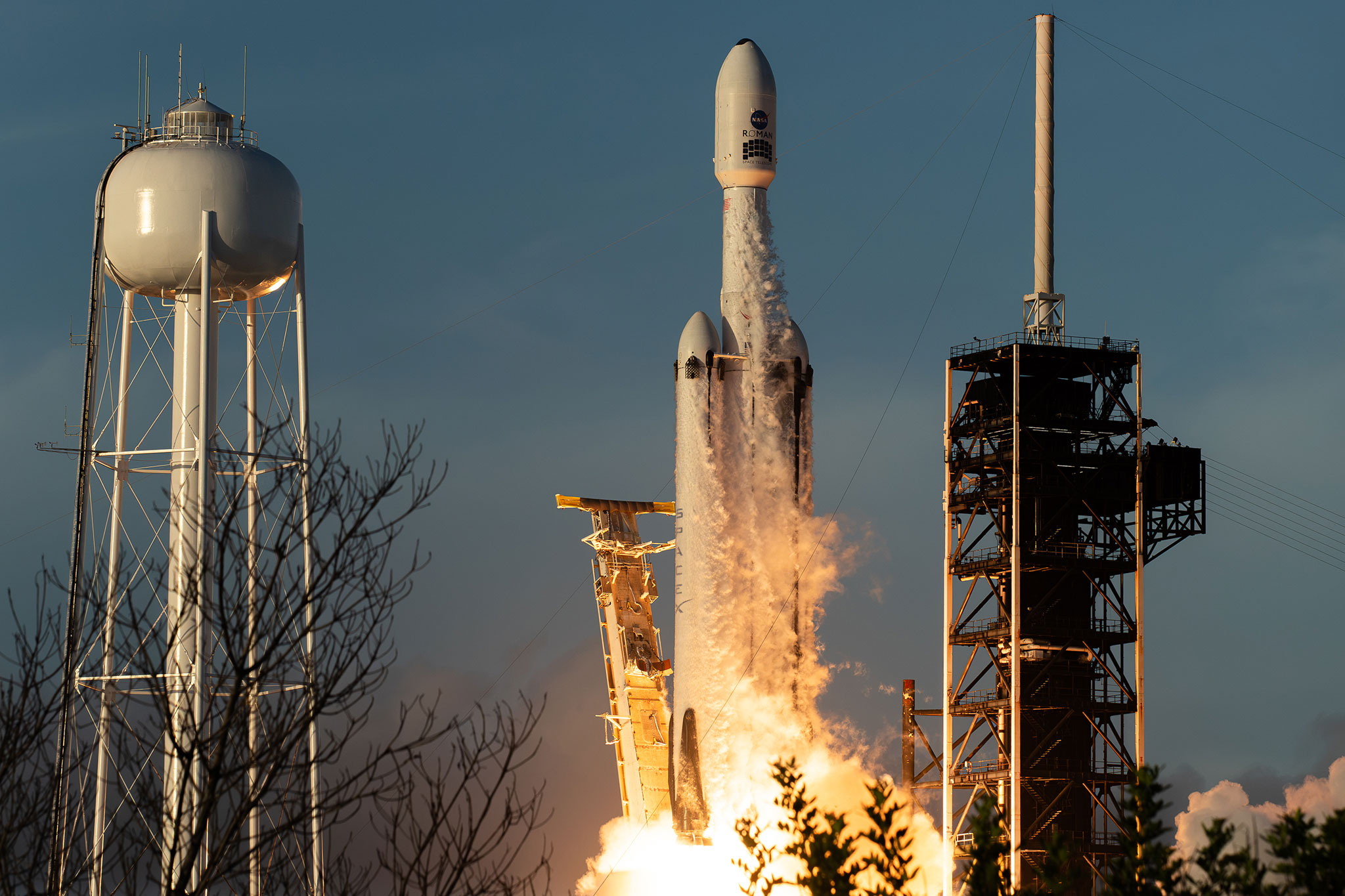
KENNEDY SPACE CENTER, Fla. — On Aug. 30, 2026, NASA’s Nancy Grace Roman Space launched onboard a SpaceX Falcon Heavy Rocket on a mission decades in the making. Its mission is simple: to survey deep space at an unprecedented speed and scope.
Named after NASA’s first chief astronomer, Nancy Grace Roman, the telescope is expected to usher in a new era of cosmic discoveries due to its 2.4-meter telescope, unique orbital placement, and advances in technology. One of these advances is the Wide Field Instrument, a 300 Megapixel camera which allows Roman to survey and image areas more than 100 times wider than that of Hubble at 1000 times the speed. By producing wide-field infrared images capable of revealing millions of previously unseen celestial objects, it can help answer some of astronomy’s largest unanswered questions regarding dark energy, dark matter, and the transformation of planetary systems.
Roman lifted off from historic Launch Complex 39A at 7:26 a.m. onboard the semi-reusable Falcon Heavy Rocket generating over 5 million pounds of thrust. The immense thrust was necessary to deliver Roman to its destination: Sun-Earth Lagrange point two, more commonly known as L2. L2 is a gravitational equilibrium point located behind earth where the combined gravitational force of the earth and sun allow objects to maintain the same orbital period as earth while remaining at the same relative position. Roman’s L2 orbit will allow it a continuous unobstructed view of deep space where it will not be blocked by the earth.
Once arriving at its permanent orbit, Roman will conduct wide-field surveys, pointing at large patches of space. Those images will pick up stars, distant galaxies, and other objects across the visible and infrared spectrum. Roman will be utilized in concert with its sister observatory, the James Webb Space Telescope which also resides at an L2 orbit. Together, Roman will survey larger areas for targets and Webb will be used to examine individual bodies of interest.
One of Roman’s key missions is the Galactic Bulge Time Domain Survey (GBTDS), a mission to complete a cosmic census of exoplanets and stellar remnants. To conduct this survey, Roman will also utilize a phenomenon called gravitational microlensing, which is created when a body of interest passes between the telescope and a more distant star. The gravitational pull of the body of interest warps the light from the distant star creating a measurable spike in brightness. This method will help astronomers detect new planets and even “rogue planets” which have no orbit and are free-flying. NASA expects this mission to lead to the discoveries of more than 1,000 new planets.
Roman will also conduct the High Latitude Wide-Area Survey (HLWAS) to map hundreds of millions of galaxies and observe the effects of dark matter on them to understand the distribution of dark matter in the universe as well as the High Latitude Time Domain Survey (HLTDS) which will discover supernovae to be used to measure cosmic distance and the acceleration of universal expansion by dark energy. All processed images from Roman will be made available to the scientific community, allowing astronomers to search for objects and stars of interest.
Top Category

Our Newsletter
Keep yourself informed with the most recent news and exclusive content.
