
.png)
NASA’s Record-Breaking Crew-13 Joins the International Space Station

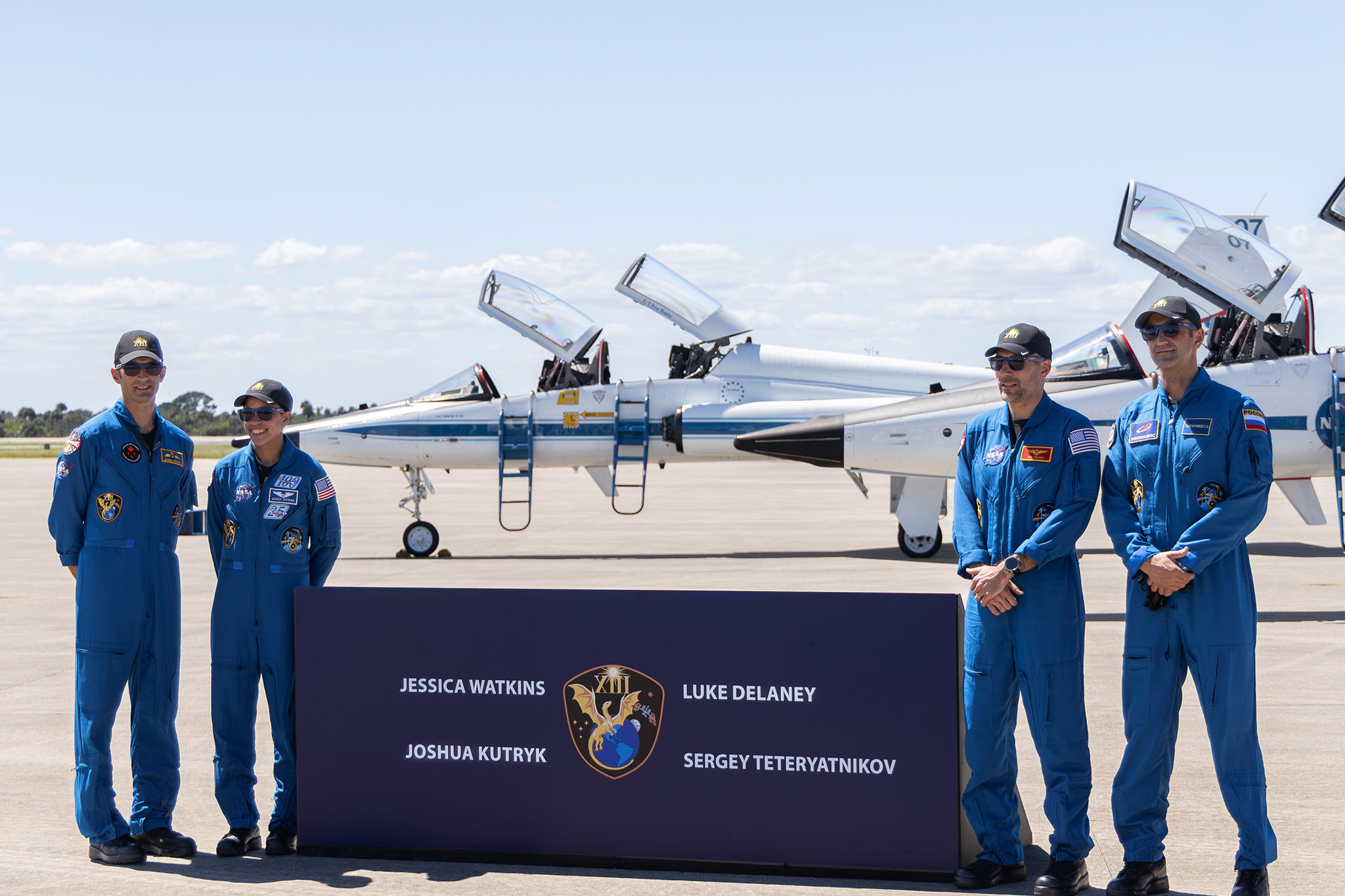
KENNEDY SPACE CENTER, Fla. – At 11:10 a.m. on Oct. 1, 2026, NASA’s SpaceX Dragon spacecraft lifted atop a Falcon 9 rocket from Space Launch Complex 40. On board were NASA astronauts Jessica Watkins and Luke Delaney, Canadian Space Agency astronaut Joshua Kutryk and Roscosmos cosmonaut Sergey Teteryatnikov. There, the team will spend six months researching advancements in medicine, astronaut health, food and deep-space science to help prepare for human exploration on the Moon and Mars.
Crew-13 lifted from Space Launch Complex 40 at Cape Canaveral Space Force Station. Following stage separation, the Falcon 9 booster separated and landed at SpaceX’s Landing Zone 40. Just 7 hours and 55 minutes after the launch, at 7:05 p.m., the Dragon spacecraft docked to the International Space Station (ISS). The rapid rendezvous set a record as the fastest launch-to-docking time for a U.S. spacecraft in the history of the orbiting laboratory.
The record-setting flight highlights modern efficiency in Low-Earth Orbit (LEO), but the crew’s six-month mission aboard the ISS represents a far larger strategic objective: forging the technological, medical and operational foundation for human exploration of the Moon and Mars.
While aboard the ISS, Crew-13 will work side by side with the crew of Expedition 75 to explore scientific questions regarding how to keep the crews healthier, how to grow food reliably in space, and how to advance technology to better future missions into deep-space.
Crew-13 brings together a blend of seasoned leadership and new perspectives. Although Delaney, Kutryk and Teteryatnikov are embarking on their first spaceflights, Commander Jessica Watkins made history as the first NASA astronaut to launch aboard a SpaceX Dragon spacecraft twice, having flown on Crew-4 in 2022.
Crew-13 exemplifies how international collaboration and scientific curiosity overlap to push the boundaries of human spaceflight. By uniting astronauts from NASA, the Canadian Space Agency and Roscosmos aboard a single mission, the crew highlights space exploration as a powerful platform for global diplomacy and shared purpose. Aboard the ISS, their research into astronaut health, in-space agriculture and life-support technology directly feeds the insistent human curiosity driving NASA forward, transforming every experiment in Low-Earth Orbit into a steppingstone toward deep-space discovery on the Moon and Mars.
Recent News

Top Category

Our Newsletter
Keep yourself informed with the most recent news and exclusive content.
%20copy.png)