
.png)
NASA-Backed Drone Research Gives Embry-Riddle Students a Real Taste of Engineering

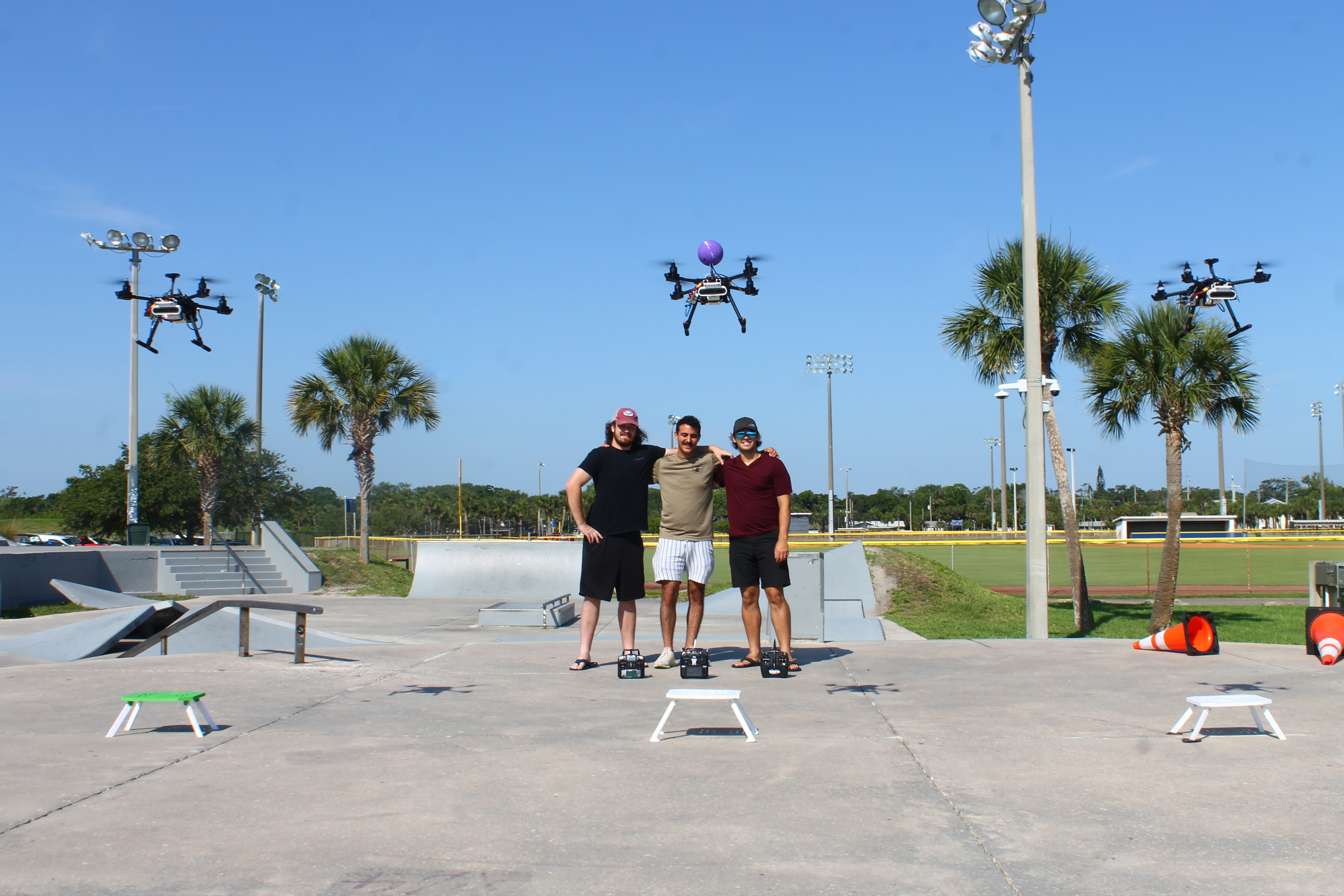
DAYTONA BEACH, Fla. — When a team of Embry-Riddle Aeronautical University students learned their drone research had earned support from NASA with an $80,000 grant, the funding mattered, but the real weight of the moment came later, in the lab, when theory became something that flew.
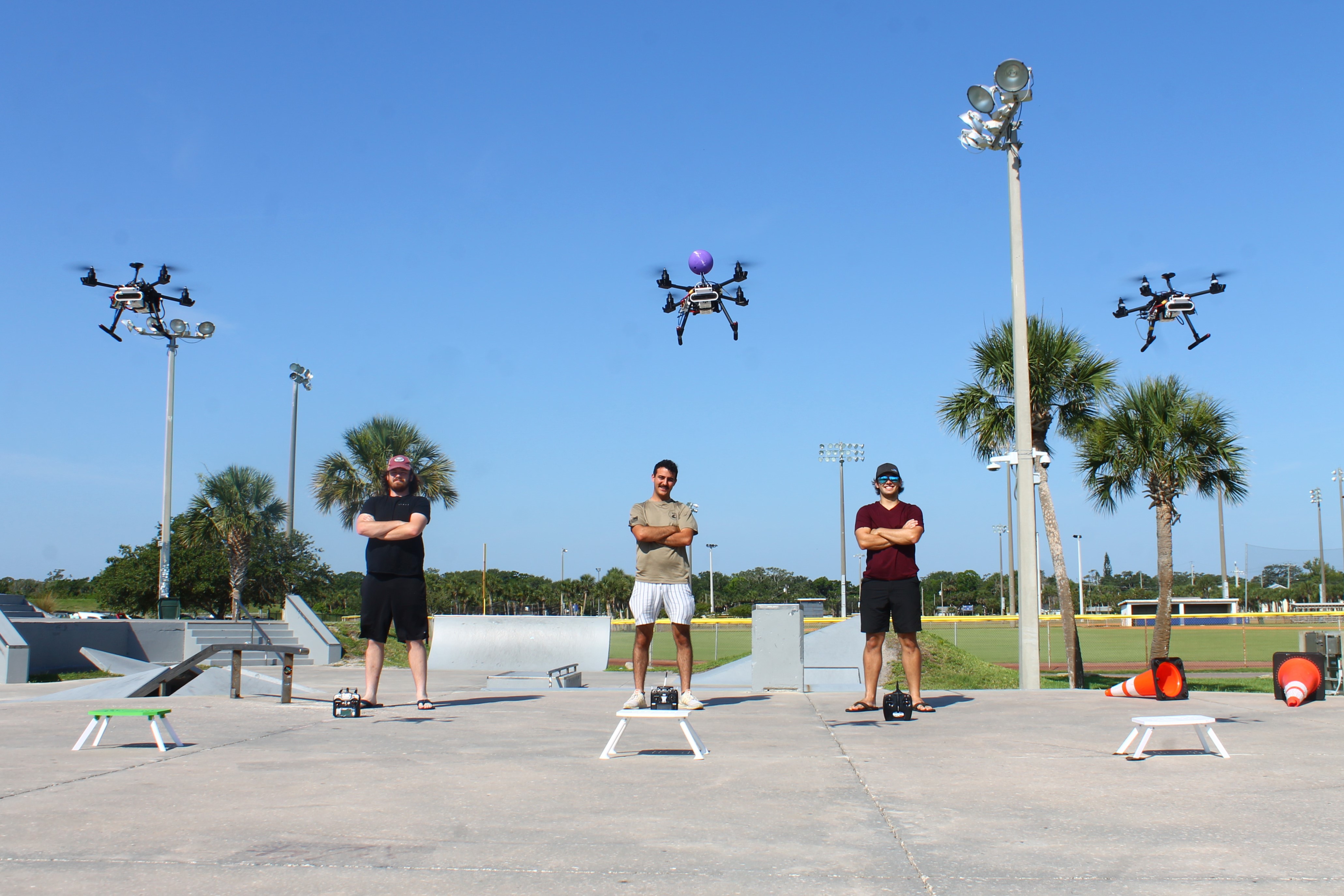
Their project, Swarm of Unmanned Aerial Vehicles using Emergence (SUAVE), is a student-led initiative to develop collaborative autonomous drones for mapping environments where GPS is unavailable, with a focus on environmental and conservation applications.
The goal of SUAVE is to improve aerial mapping by using a group of drones working together instead of traditional single-aircraft methods. Instead of relying on GPS or repeated flight passes, the drones collect data and combine it after flight to create detailed 3D maps. The project is designed to work without GPS or central control systems, using standard sensors, pushing students to solve real-world engineering challenges.
In 2024, that work culminated in a peer-reviewed publication presented at SPIE Defense + Commercial Sensing, marking a milestone not just for the research, but for the students behind it: Daniel Golan, Patrick Kennedy, Bryan Gonzalez, Ryan Taylor, Joseph Perry, Ethan Thomas, Ryan Ebrahimi, Kyle Fox and their faculty advisor, Dr. Sergey V. Drakunov.
At its core, SUAVE is about collaboration between machines and between students learning what engineering looks like beyond the classroom.
For Gonzalez, 25, who recently earned a master’s degree in mechanical engineering and serves as assistant lab manager for the Engineering Physics Propulsion Lab (EPPL), the project unfolded alongside his graduate coursework, bridging the line between class and practice.
“It allowed me to solidify the concepts and understandings that I received from my classes,” said the Georgia native. “I learned and understand new things from my master's classes, come back and teach them to Daniel and Patrick through explaining stuff, and then we typically go from there on certain things.”
That cycle of learning, applying, and teaching became routine as the team worked through technical challenges together.
“We’d all come back together at a meeting, or we’d come together when trying to solve something on SUAVE,” Gonzalez said. “It allows us to solidify those things that we learned from our classes, but it allowed us to advance our projects as well.”
While SUAVE was designed with environmental and conservation applications in mind, specifically topographical mapping of state parks and conservation areas, Gonzalez said the team was also aware that the technology could attract interest beyond the scope.
“We designed it for topographical mapping of state parks,” he said. “But I also understand where the technology is going.”
As drone autonomy and swarm technology continue to advance, Gonzalez acknowledged that while the team’s proposal centered on environmental mapping and conservation, similar systems could be adapted for defense, construction planning, or security response—a reality the team discussed openly, even as they prioritized non-military use cases.
“It’s kind of a double-edged sword,” he noted.
When the team first learned SUAVE had received a NASA Undergraduate Student Research Challenge grant, the reaction was more complicated than celebration.
“We thought, ‘Oh, they didn’t approve our full budget. We’re only getting 40 grand,” Gonzalez explained. “Which was okay with us. We figured we could make it work.”
Only later did they realize the grant would ultimately provide the full $80,000, distributed in phases with additional requirements attached.
Those requirements, including fundraising and interdisciplinary collaboration, helped shape one of SUAVE’s defining features, its breadth of involvement throughout the campus.
“When we had been working on SUAVE, we had people from every college at the university,” Gonzalez said. “We had people from the College of Business, we had people from UAS, we had students, obviously from the College of Engineering. But we also had students from the College of Arts and Sciences, from the Engineering Physics Program.”
That cross-disciplinary structure mirrored how large-scale engineering projects function outside the university, he referenced.
“That was probably one of the most interesting parts of it,” he said. “We were able to bring so many people in and have so many perspectives on this project.”
For Perry, a Daytona Beach native and junior majoring in mechanical engineering with a specialization in robotics manufacturing and prototyping, the project offered something lectures alone never could.
“I would say that the experience I gained working with SUAVE was almost more valuable than all of my classwork,” Perry said. “In class, you learn theory and principles, and in the lab, you learn how to apply those things to a real problem.”
Perry joined EPPL during his freshman year after hearing a familiar refrain at career fairs: employers wanted hands-on project experience. A friend brought him into the lab, where he met the SUAVE team and saw the drones firsthand.
“I immediately took interest,” said the 21-year-old.
His role focused on the physical aspects of the project, including building and repairing drones, designing and manufacturing custom components, and configuring flight controller software. Seeing those parts function in real time reshaped how he viewed his education.
“Being able to look at the drones we built and point out which parts of it I did is extremely rewarding,” Perry said.
Though he joined after the NASA grant had already been awarded, its impact was unmistakable.
“Having so much financial freedom was a large part of why we were able to get successful results,” he said. “It also offered a reminder of reality that it's not all fun and games; that the work we put in needed to get completed because of the requirements from NASA.”
That balance between freedom and accountability was intentional, according to Drakunov, a professor in Embry-Riddle’s Department of Physical Sciences whose expertise spans control theory, applied mathematics, and engineering physics. Drakunov emphasized that SUAVE was never meant to be a “toy project.”
“You can build something, and it will look like a toy,” said Drakunov, a professor in ERAU’s Physical Sciences Department. “You enjoy it, you get satisfaction that you built it. But the main thing for me is to have some good physics and math — something innovative that people didn’t try before.”
That innovation focused on dual quaternions, a mathematical method that allows drones to control both movement and rotation at the same time. While commonly used in satellite systems, it is rarely applied to drone swarms. Drakunov taught the concept and challenged students to apply it in real-world hardware.
“They spent days and nights experimenting,” he said. “Mathematics is one thing. But building it, programming it, putting it into the microprocessor, and making it work in reality, that’s very difficult. They did it all.”
The project’s technical success mattered, but Drakunov said the educational value mattered more.
“Students come here because they want real things, not just theoretical solving in class,” he said. “Doing a project is the best way to learn something. When you are doing it, you realize why this knowledge is needed.”
That lesson became clear during the inevitable setbacks.
“If something can go wrong, it will go wrong,” Perry said. “That was a very common theme throughout the project.”
Broken parts, failed tests, and time constraints forced the team to adapt, skills Perry says now shape how he approaches coursework and problem-solving beyond the lab, particularly given how much responsibility students are trusted with early on.
“Now, I actively look for ways that everything can be used in daily life or other engineering problems,” he said. “Even as a brand-new member, what you do actually matters,”
“A part I designed in the first month of joining the lab is still being used on the drones.”
As SUAVE continues to evolve, its future applications remain open-ended. Gonzalez sees potential in both continued research and real-world deployment — even as the team remains aware that emerging drone technology often draws attention beyond its original scope.
For the students who built it, the impact is already evident in the confidence gained, the skills sharpened, and the moment when engineering stopped being theoretical and started taking flight.
Top Category

Our Newsletter
Keep yourself informed with the most recent news and exclusive content.
%20copy.png)