
.png)
25 Years Later: Remembering 9/11 Through Those Who Lived It

The day started as any other day for thousands of workers on the morning of Sept. 11, 2001. Lower Manhattan held bustling streets, bodegas and the World Trade Center. People walked to work under a deep blue, cloudless sky, not knowing that at 8:46 a.m., the sun would be covered with debris, smoke and fire.
This year marks the 25th anniversary since the attacks on Sept. 11, 2001. It was a day in history that changed family lives, security and the aviation industry as we know it today.
Future pilots and ATC controllers alike are being taught through a post-9/11 world, a world where TSA security and heightened security measures in airports are the norm. The events of Sept. 11, 2001, changed how aviation would run and Embry-Riddle Aeronautical University’s accredited aviation program was affected among many programs.
The View from the Skies: Dr. Michael McCormick
Few people understand the events of Sept. 11 from the perspective of air traffic control better than Dr. Michael McCormick. Today, he works as the associate professor and program coordinator of Air Traffic Management at the Embry-Riddle Aeronautical University’s Daytona Beach Campus.
On Sept. 11, 2001, Dr. McCormick served as the FAA’s air traffic manager at New York Center, where he made the unprecedented decision to declare “ATC Zero” and shut down the center’s airspace as the attacks unfolded.
Twenty-five years after the attacks, Dr. McCormick held a live presentation for Riddle students at all campuses. He reflected on 10 important lessons that he learned that morning, emphasizing leadership, community and resilience.
The live presentation was held in the College of Aviation’s atrium at Embry-Riddle’s Daytona Beach campus, where every seat was filled with students from all majors, with rows of students against the back wall wanting to hear his experience and his story.
When recounting the events of that morning, Dr. McCormick reflected not only on the decisions he had to make, but also the emotions he was feeling as a person whose career had been devoted to aviation.
“I was angry. I was angry that somebody takes something that I loved, aviation... and use it as a weapon against my country, which I love.”
Dr. McCormick broke down his experience minute by minute. His decisions were unlike anything air traffic controllers had faced before, making his choices some of the most important during the attacks. Under his leadership, the New York Center’s airspace was shut down to remove aircraft from the system.
“That's what's known as ATC Zero. It's not designed for this… when you have an equipment problem and you can no longer provide air traffic control services, then you can shut down the airspace. I chose to use it for this.”
After the operational challenges, Dr. McCormick talked about the community that had united after the tragic days. As New Yorkers searched for loved ones and came together to support first responders at Ground Zero, he witnessed a resilience that stayed with him long after the attacks.
His presentation focused on the timeline of events on Sept. 11, but Dr. McCormick also emphasized that the lessons he learned that day stretched far beyond a single day. He encouraged students to become leaders, support one another and remain prepared for the unexpected.
“The advice I would give to… the future traffic controllers of the world is… if you see something, say something. That's the only way you're gonna fulfill your mission of being the guardian of the skies.”
The View from the Ground: Lieutenant Suesette Garcia
While Dr. McCormick experienced Sept. 11 from inside the nation’s air traffic control system, Lieutenant Suesette Garcia witnessed the attacks firsthand from the streets of New York City. Before joining Embry-Riddle’s Campus Safety & Security Department, Lt. Garcia served with the New York City Police Department at Ground Zero on the day of the attacks.
Like many New Yorkers, Lt. Garcia remembers the morning beginning with complete normalcy before everything changed.
“It was a beautiful, picture-perfect day. The clouds were perfect, the sun wasn’t shining too bright, the birds were chirping… it was too perfect.”
Lt. Garcia was present when the second plane hit, and later volunteered at Ground Zero, helping with the response efforts in the aftermath of the attacks. While on the way to help with the evacuation efforts at the World Trade Center, Lt. Garcia realized the tragedy unfolding around her was unlike anything she had ever experienced.
“I saw people falling out of buildings… When I saw that, I knew it was a life-altering moment.”
Twenty-five years later, Lt. Garcia believes one of the lasting impacts of Sept. 11 can be seen in the evolution of security practices around the country.
Although her career has taken her from New York City to Daytona Beach at Embry-Riddle, Lt. Garcia said the mission that inspired her to stay a police officer has never changed, even after coming to campus.
“All the students are like my kids… So, if I have to go to the forefront, and make sure I protect and serve, just like I did before, I’m willing to do it.”
For today’s college students, many of whom were born after Sept. 11, 2001, the attacks exist primarily through history books, documentaries, annual commemorations and security measures they wouldn’t think twice about. Lt. Garcia hopes they understand the lessons of that day remain just as relevant as today.
“I love working for campus safety. I love working for the students, the faculty and the staff. I’m fully devoted when I’m out there… [I’m] fulfilling my purpose, which is to help others, whenever I can.”
Stories like those of Dr. McCormick and Lieutenant Garcia are essential to preserving the memory of Sept. 11. Their experiences are among thousands that reveal not only the tragedy of that day, but the resilience of a nation that came together in the face of unimaginable loss.
Across Embry-Riddle’s campus, students continue to honor the lost lives through annual acts of remembrance that reinforce the importance of service, sacrifice and resilience.
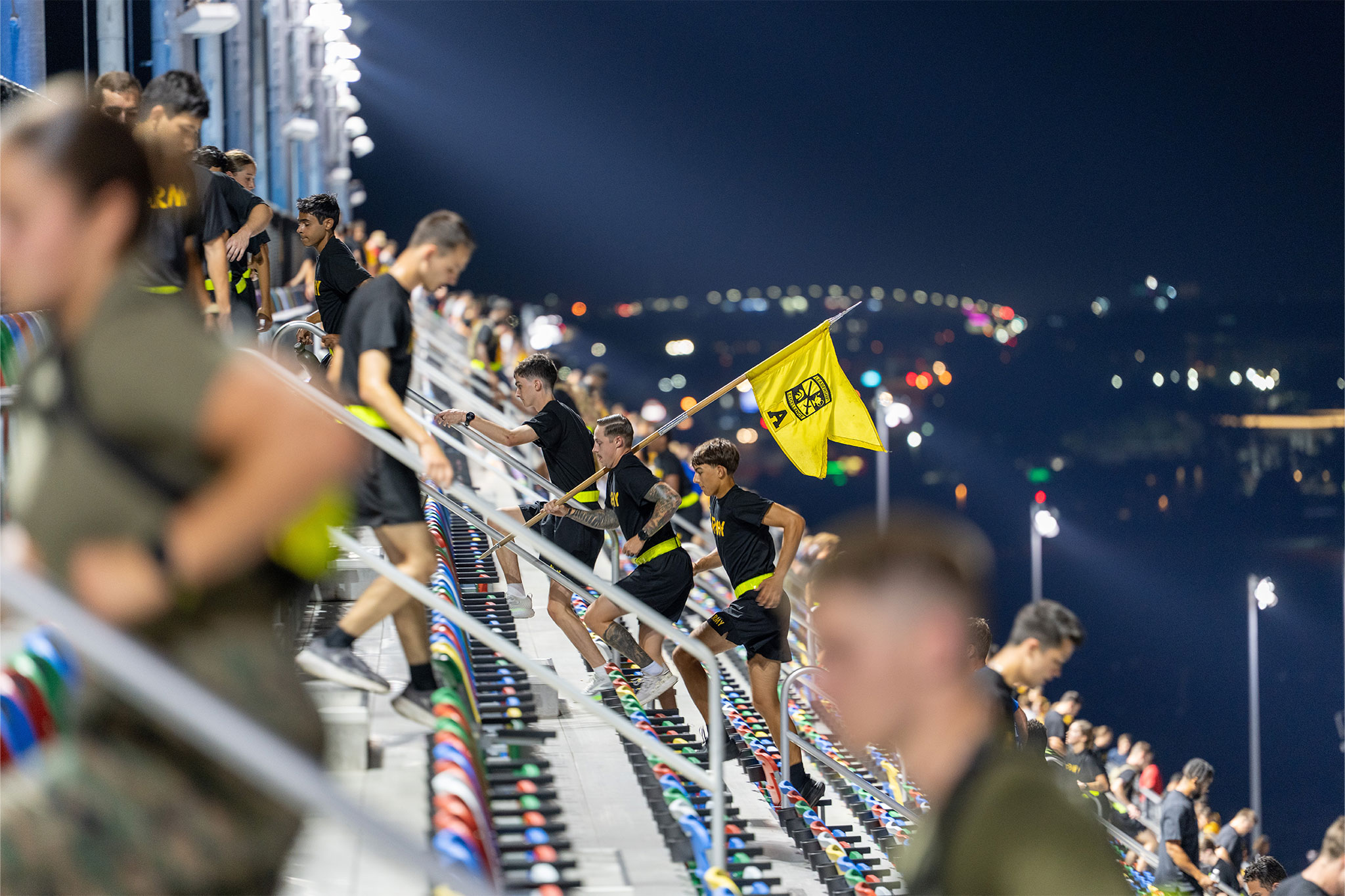
Cadets from all branches came together to honor the lost innocent lives and the first responders who risked their lives. The annual tribute was held by Embry-Riddle’s ROTC program at the Daytona International Speedway.
For Cadet Ayden Brown, a freshman whose parents both served in the Army, the climb is a powerful sign of unity across branches.
“It is a big representation of that fact that their sacrifice in service will never be forgotten,” Brown said. “Over two decades later, we remember all of them. We can still come out, represent, give our respect and take on just a minuscule of a fraction of what they did for us.”
For older leaders, the event serves as a vital bridge across generations. Senior Military Instructor MSG Jaime Glass, who enlisted shortly after watching the news on Sept. 11, noted that the growing gap between today’s students and the event itself.
“We are starting to get to that generation where 9/11 is far away from where they are at, so I think going through this may flip in their mind what someone would have to go through in that moment,” Glass shared.
LTC Craig Maddy, Army ROTC professor of military science, echoed a similar sentiment, highlighting the importance of active reflection: “If we are not deliberate about reflecting on that, then we will forget the importance of it.”
PHOTO CAPTION: The cadets took 2,100 steps in remembrance of the heroes that showed courage, sacrifice and strength in the wake of a tragedy.
Embry-Riddle’s Young Americans for Freedom chapter displayed 2,977 flags outside of the Center of Faith and Spirituality, each flag representing a life lost in the attacks. The annual flag display helps younger generations understand the scale of the tragedy.
Outside of the Mori Hosseini Student Union, Embry-Riddle’s Delta Chi student chapter displayed flags for the commemoration. The flags made out the shapes of the World Trade Center, the Pentagon and Flight 93, the visual reminder evident to every Riddle student that walked by.
On Unity & Sacrifice:
“It is one of the only times we are really unified, doing something as a group... Over two decades later, we remember all of them. We can still come out, represent, give our respect and take on just a minuscule of a fraction of what they did for us. It is a big deal.”
- Cadet Ayden Brown, Freshman
On Bridging the Generation Gap:
“We are starting to get to that generation where 9/11 is far away from where they are at, so I think going through this may flip in their mind what someone would have to go through in that moment.”
- MSG Jaime Glass, Senior Military Instructor
On Never Forgetting:
“Deliberate events are a way for us to deliberately remember and interact with each other in a meaningful way... If we are not deliberate about reflecting on that, then we will forget the importance of it.”
- LTC Craig Maddy, Army ROTC Professor of Military Science
Recent News

Top Category

Our Newsletter
Keep yourself informed with the most recent news and exclusive content.
%20copy.png)